Motivation
Finding past papers for a specific Engineering module means digging through the university's exam archive year by year. I wanted to be able to search for papers easily and keep track of the ones I had done. Now students can spend their time on the papers rather than searching for them.
Problem outline
- The official archive is organised by year and by exam session, not by module, and module codes changed in 2018/19, so older papers sit under different codes.
- Collecting over a thousand links by hand wasn't practical, and they need re-checking after every exam session.
- The site must not host or redistribute any exam papers. It may only link to the official PDFs, which open for students already signed in to their university account.
- Many later-year modules have no written exam (projects, labs, continuous assessment), and some new modules replaced older ones, so their pages would otherwise be empty.
How it works
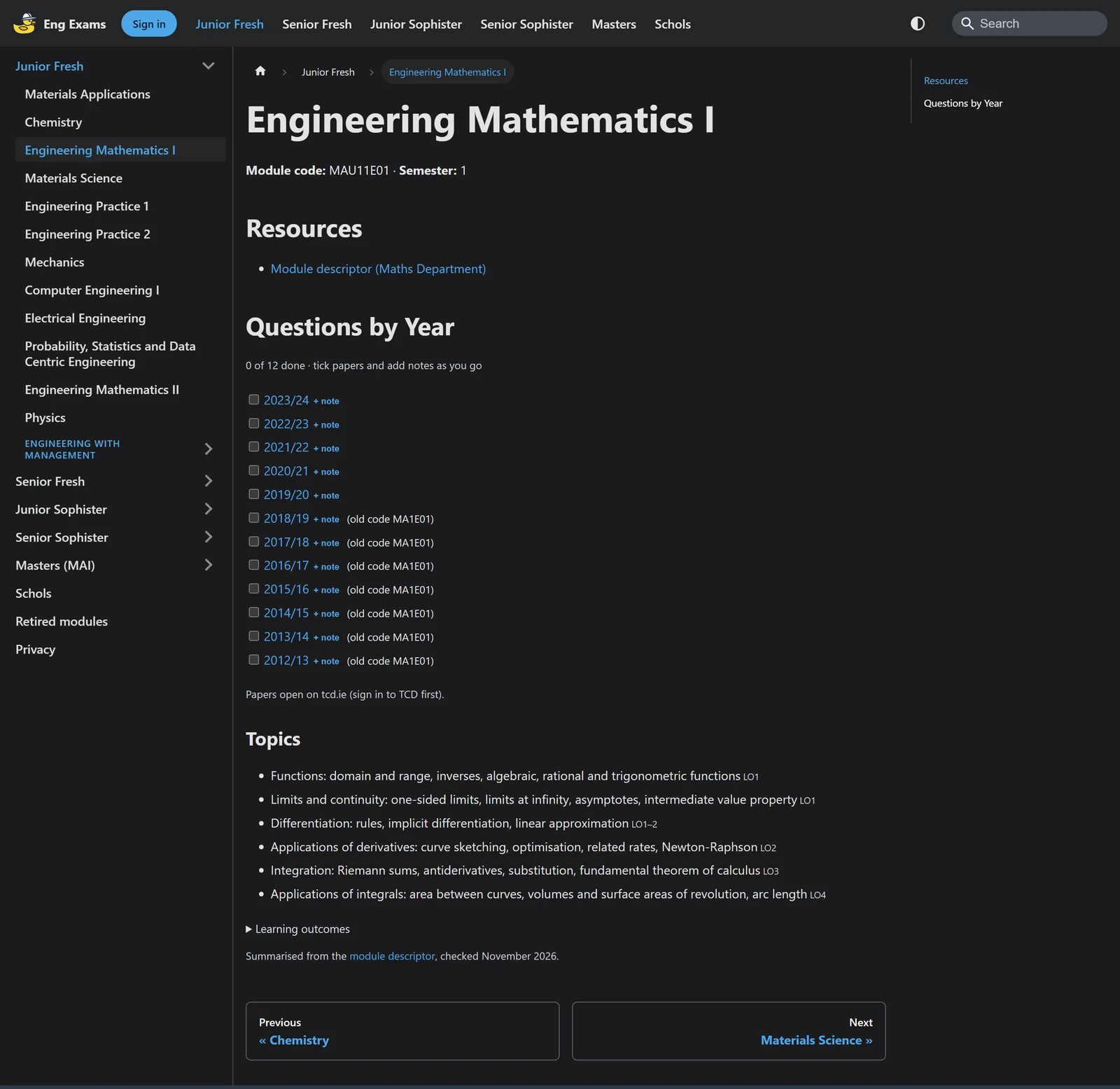
- Static site: built with Docusaurus (React) and deployed on Vercel, with pages for all five years, every Engineering stream, Engineering with Management, and the Foundation Scholarship papers.
- Link collection: a small script that a signed-in student pastes into the browser console on the archive page. It gathers the links, and an import script matches each one to its module. It uses the file name over the link text and maps old module codes to new ones, then checks the mapping is consistent. A separate read-only checker reports missing papers, links that have moved, and codes with no page.
- Modules without papers: these show an assessment summary paraphrased from the public module descriptors. Modules that replaced an older one show the previous module's papers, and retired modules have their own page.
- Study tools: offline search, tick boxes to track which papers you've done, and a topic list per module taken from its learning outcomes. "My modules" on the home page opens on the current semester's modules for your year and stream, with core modules and options listed separately.
- Accounts: optional sign-in with a 6-digit code received by email, protected by a Cloudflare. The papers you have ticked off and your course sync across devices, and the database's row-level security means each student can only read their own data. New accounts are asked for their year and stream on first sign-in. Accounts can be deleted from the site in one step.
- Security and privacy: strict security headers (Content Security Policy, HSTS, frame blocking), dependency audits, and cookie-free analytics (Vercel Web Analytics). A privacy page explains exactly what is stored.
Results
- Over 400 visitors in 7 days.
- Live, with 1,198 paper links for 183 module codes across 332 module pages, going back to 2012/13.
- Assessment information for over 50 modules that have no exam paper.
- What I learned: getting messy real-world data (inconsistent file names and renamed module codes) into a clean structure took more work than building the site itself. Adding accounts taught me to design around privacy from the start: storing as little as possible and letting users delete everything themselves.
Images